
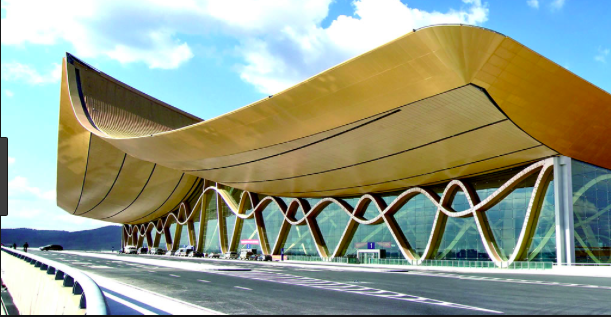
One of the biggest and busiest airports in China is set to grow much larger. Kunming Changshui International has only been open for six years, but it recently received national approval — and presumably state funding — to increase its ability to handle passengers by nearly 300 percent over the next decade.
Today, Changshui is the country’s sixth busiest airport based on a matrix involving passengers, aircraft ‘movements’ and cargo handled. In 2017, the facility handled 44,727,691 passengers, trailing only Beijing, Shanghai, Guangzhou, Chengdu and Shenzhen, according to statistics compiled by the Civil Aviation Administration.
The newly approved 2018 Changshui Airport Master Plan eyes a day in the not-so-distant future when the facility will see passenger traffic exceed 120 million people each year. In order to meet such demand, Yunnan province’s main travel hub will add additional 4,000-meter runways to augment the two that already exist.
A previous expansion plan first outlined in 2015 — a mere three years after Changshui first opened — called for the construction of a second major terminal and two extra runways. Already underway, that scheme has since been updated and was given the green light by Beijing in mid-October of this year. No verifiable cost estimates for the expansion have yet been made public.
Under the 2018 Master Plan, Changshui’s future runway count has risen to five and two ‘satellite facilities’ are scheduled for construction to supplement terminals 1 and 2. Work on Terminal 2 broke ground in 2015, and is expected to be completed sometime around 2020, as is at least one of the auxiliary runways. All construction detailed in the 2018 Master Plan will reportedly be finished by 2030.
Changshui was opened in 2012 at a cost of 23 billion yuan (US$3.3 billion) as a replacement for Kunming’s outdated and inadequate Wujiaba Airport. At that time, the facility was included in the ‘Go West’ development program (西部大开发), an enormous domestic economic policy designed to boost development in western China. Today, that strategy has been subsumed by the country’s Belt and Road Initiative.
It has long been rumored that Kunming would land contracts for an ever-growing number of intercontinental flights. And while connectivity between Yunnan and the countries of South and Southeast Asia have jumped significantly since 2012, consistent direct links to Europe and North America have not been so quick to materialize. With the addition of even more airstrips built to handle the world’s largest passenger planes, Changshui may finally be on its way.
Source: Go Kunming
 Tampa International Airport is growing, with a $2 billion expansion and renovation project underway. The phase-one work included road work, a new 1.4-mile SkyConnect people mover, an expansion of the main terminal, a new rental car center and the addition of several local restaurants to the dining options. Phase two, which starts this year, includes a 17-acre commercial development with a hotel and curbside expansion work. Phase 3 , which has not begun yet, will see the addition of a new 16-gate terminal.
 Sarajevo Airport has commenced the multi million euro expansion of its terminal building. Local company ANS Drive has been contracted to carry out the work valued at 15.3 million euros. The project includes the addition of 10.000 square metres of space to the existing terminal building, as well as the construction of an office/business facility at the airport, worth three million euros. The two projects are being financed from the airport’s own funds. «The expansion of the passenger terminal and the construction of a business facility are important strategic projects for Sarajevo Airport, which will provide capacity for further growth», General Manager, Armin Kajmaković, said. Upon completion, the terminal building will have the capacity to handle two million passengers. Currently, Sarajevo can welcome one million travellers per year, with the airport set to surpass that figure over the next two months. The project’s completion is scheduled for late 2019. Previously, the old terminal A building was demolished in order to make way for the expanded facility.
 In an urgent bid to address overcapacity and modernize existing infrastructure, the Indonesian government has turned to the private sector to fund a series of airport projects across the sprawling archipelago. In recent days, the government has revived talks of a new $10 billion international airport to serve as an alternative to Jakarta’s Soekarno-Hatta Airport, which has operated beyond design capacity for more than 10 years. Authorities have earmarked reclaimed land some nine miles north of Soekarno-Hatta for the project, plans for which call for financing from a private-public partnership scheme between investors and state-owned PT Angkasa Pura II.