
Spain’s Ferrovial, Canada’s PSP eye GVK Airport stake

Canada’s Public Sector Pension Investment Board, or PSP Investments, and Spanish airport operator Ferrovial,
which runs Heathrow of London, among others, are the two final suitors advancing on a large share purchase in GVK Airport Holdings, people directly familiar with the matter said.
GVK owns and operates the country’s second busiest Mumbai International Airport, and will manage the proposed Navi Mumbai International Airport too. Citigroup is said to be advising the transaction, which could conclude with one of the two bidders in the next two months. Financial details of the potential transaction could not be ascertained at this stage.

Earlier this month, GVK Power & Infrastructure sought shareholder nod to sell over 50% stake in the privately held airports holding company for raising up to Rs 8,000 crore. The capital raised will be deployed to pare debt and for developing the Navi Mumbai airport. GVK Airport Holdings has over Rs 8,000-crore debt, while the group’s overall debt hang is well over Rs 20,000 crore.
One of the sources cited earlier said the share sale to one of the bidders would be up to 49%. However, GVK Airport is likely to go ahead with an IPO plan sometime next year, which would see the promoter stake fall below 50%. The company is a fully owned subsidiary of GVK Power & Infrastructure.
PSP and Ferrovial were in the final lap after the latest phase of protracted deal-making in GVK Airport had attracted several bidders, including Australian infrastructure investor AMP Capital, Abu Dhabi Investment Authority and Malaysia Airports, among others.

Source: The Times of India (Business) 
Philippines: Award of crucial airport projects seen in early ’19

With roughly a month to go before the end of the year, the Department of Transportation (DOTr) acknowledged that the final awarding of key private sector-proposed airport projects in Manila and Bulacan could be completed by early 2019 at the soonest.
Transportation Undersecretary for planning Reuben Reinoso yesterday said the two projects—San Miguel Corp.’s P800-billion international airport in Bulacan province and Naia Consortium’s P102-billion offer to modernize and operate the Ninoy Aquino International Airport—had yet to be cleared by the Investment Coordination Committee of the National Economic and Development Authority.

The two projects form part of the DOTr’s so-called multiairport policy, which aims to address worsening congestion in Naia, the Philippines’ main gateway.
The go-ahead of the Neda-ICC will be followed by the approval of the Neda Board, which is chaired by President Duterte. As unsolicited proposals, the final step is a bidding process known as Swiss Challenge, which requires at least 60 days.
Reinoso said they were still targeting to launch the Swiss Challenge, wherein rival bidders would be allowed to submit offers, before the end of 2018. But he explained that this would depend on when the projects would be approved by the Neda ICC.
Reinoso said the offer of Naia Consortium, a group of seven conglomerates, remained with the Neda-ICC pending the submission of additional documents by the Manila International Airport Authority.
He added that the concession agreement for SMC’s airport offer was being reviewed by the Department of Finance and Office of the Solicitor General. It will then be handed over to the Neda-ICC for “reconfirmation.”
Naia Consortium and SMC hold original proponent status (OPS) for their respective projects. This means they both carry a big advantage during the Swiss Challenge. OPS holders can still win the project because they have the right to match rivals with better bids.
Naia Consortium’s members are Ayala Corp., Aboitiz Equity Ventures, Alliance Global Group Inc., Asia Emerging Dragon, Filinvest Development Corp., JG Summit Holdings Inc. and Metro Pacific Investments Corp. Its technical partner is Changi Airports International.
Through a 15-year concession, Naia Consortium wants to increase capacity in Naia to around 65 million passengers yearly in four years. This is double the existing design capacity of 31 million passengers a year. Naia’s four passenger terminals served 42 million passengers in 2017.
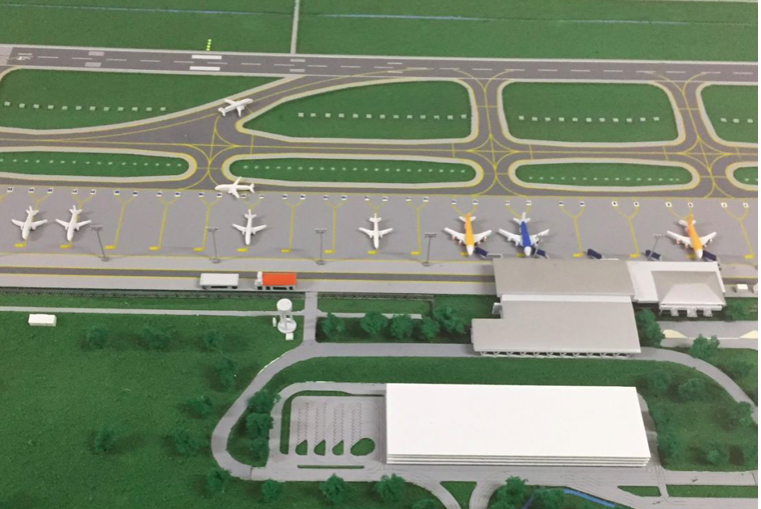
On the other hand, SMC is planning a brand-new airport in Bulakan, Bulacan, that will have as many as six parallel runways and a capacity of over 100 million passengers yearly.

Another key part of the multiairport strategy is Clark International Airport, Pampanga’s gateway that is currently being expanded under the public-private partnership scheme.

Source: Inquirer Net

Thailand: New passenger terminal and facilities launched Krabi airport

The Minister of Transportation has officially launched a new terminal at the Krabi International Airport this week.

Transport Minister Arkom Termpittayapaisith officially officiated at the launch of the new passenger terminal at the airport yesterday. New common-use check-in counters were also launched at the ceremony.

Khun Arkom says, “The construction contract has already been running since August 28 last year. The project is part of the developing infrastructure for the airport as the passenger traffic continues to build. It is a good start to improve the airport.”

“This new terminal is the third terminal. We will also renovate the first and the second terminal and parking areas.”

“The new terminal will be able to handle 3,000 passengers per hour. The Krabi International Airport is located on more than 2,000 rai of land and will be able to handle 4.23 million passengers per year when the new construction is completed.”

Source: The Thaiger

Jakarta: LCC terminal to attract new airlines

Airport terminals for low-cost carriers (LCCs) are targeted to attract inbound flights from new airlines, especially foreign ones, an airport expert stressed.

«Yes, this is one of the aims. There are still a lot of operating LCCs that are yet to fly into our airport,» said Muhammad Awaluddin, CEO of PT Angkasa Pura II, during a discussion panel in Jakarta, Thursday.

PT Angkasa Pura II is a state-owned enterprise that manages airports in several regions of Indonesia.

Low-cost foreign carriers that are yet to enter Soekarno-Hatta Airport in Jakarta include Viet Jet, Jeju Air, Malindo Air and Nok Air.

Awaluddin stated the concept of low-cost carrier terminal will be materialized during the revitalization process of Soekarno Hatta Airport`s Terminal 1 and 2.

The revitalization of the two terminals is scheduled to be completed in 2022. Some nine million more passengers per year are expected to use them, taking their capacity to 25 million per year.

The revitalization called for an investment of Rp2.7 trillion for terminal expansion and the addition of tools that support the digital concept and smart airport.

«It is scheduled to be completed some three years from now, but the implementation of the concept will be carried out next year,» he remarked.

He further mentioned that Terminal 1 is specifically dedicated to low-cost domestic flights, while Terminal 2 is designated for low-cost domestic and international flights. Terminal 3 is for domestic and fully-serviced international flights, while the use of Terminal 4 is yet to be determined.

«If Terminal 4 is ready, it will be easy for us to make arrangements,» he stressed.

Meanwhile, Terminal 4 itself is scheduled to be built in 2020, and the focus will be on determining its design next year.

Source: Antara News