


Juan Santamaria Airport in Costa Rica Will Inaugurate New Building in December

This December, the Juan Santamaria Airport will inaugurate a new four level building of six thousand square meters that will add four new boarding gates, a VIP room and an area for pets.

With this new addition, Costa Rica’s main airport will be able to handle 600 more passengers per hour. This new building is part of the works of project La Candela which will be completed by mid-2019 and which contemplates works with a total value of US$39.5 million.

“The works of La Candela project will have effects that will make a more efficient airport with faster take offs and as many as 12 additional airplane take offs per hour. This means, for example, that the waiting times in peak hours will be more agile and the airlines that operate the airport will be better served” explained Rafael Mencía, Executive Director of AERIS.

The investment in the building itself, called Block V represent US$20 million and will be concluded in December this year. Parallel to the development of Block V the air terminal will extend to the West in a space of four levels at basement level, arrivals, exits and mezzanine, project valued in US$17 million and will involve 16 additional positions for passenger check-in or luggage drop off, 15 kiosks for self-check-in and additional carrousel for luggage pick up, expansion of the customs area and additional office space for the airlines.

Source: The Costa Rica Star

Passenger traffic increases at Uganda’s Entebbe Int’l Airport

Uganda’s Entebbe International Airport has recorded an increase of international and transit passengers, with the figure expected to grow further, according to authorities.

Civil Aviation Authority (CAA), the country’s air transport regulator, said in a statement on Tuesday that while the airport recorded close to 1.1 million international and transit passengers during the period January to August 2017, it has so far recorded about 1.2 million international and transit passengers from January to August 2018, representing an increment of over 120,000 passengers so far.

«The figures are likely to increase even more by the end of the year considering that the last quarter of the year (October to December) is usually busier in terms of air travel,» the CAA statement said.

The increase in the number of passengers is attributed to the country’s recent conclusion of new bilateral air service agreements with different countries such as Saudi Arabia, Israel, Switzerland and Canada.

«Some of Canada’s airlines are already having code-share agreements with international operators to Uganda. Air Tanzania recently resumed operations to Uganda and discussions are ongoing with several potential air operators to Entebbe including one who plans flights to the United Kingdom,» the statement said.

Several air operators such as Emirates, Qatar and Rwandair recently changed aircraft to Entebbe from smaller to bigger ones. Other airlines also increased flights between Entebbe and other international destinations.

A total of 1.6 million international and transit passengers were recorded in 2017 and the air transport regulator is hopeful the number will be surpassed by end of 2018.

«All these developments, including increase in frequencies by air operators and change of aircraft type from smaller to bigger types, show the growth in Uganda’s air transport industry,» the statement said.

Uganda with financing from China is upgrading Entebbe International Airport to handle more traffic and cargo. The expansion includes an extension of the passenger terminal, construction of a new cargo center and refurbishment of the airport’s two runways.

Source: Xinhuanet Africa

Vietnam set to bring Hanoi’s Noi Bai International Airport expansion back to front burner

The government is considering the expansion of Hanoi’s Noi Bai International Airport to handle 80-100 million passengers a year by 2050.
Deputy Prime Minister Trinh Dinh Dung has just instructed the Ministry of Transport to review the airport expansion plan drafted years ago.

Noi Bai is one of Vietnam’s most important airports and an international gateway to the north, but is overloaded, he said. The airport has a capacity of 25 million passengers and last year served 23 million.

He told the ministry to work with consultancies to finalize plans for the development of the airport until 2030 with a vision to 2050.

It should also collaborate with city authorities to come up with a plan for land acquisition and resettlement of people, he added.

The plan sought to increase the airport’s capacity to 50 million by 2030 and 80-100 million by 2050.

It was estimated to totally cost $5.5 billion, $3.5 billion for construction and $2 billion for land acquisition and resettlement of affected people.

The funding for the review of any changes to the plan will come from non-refundable official development assistance from France.

The transport ministry last month ordered repairs to the airport to fix cracks in the runway and material falling off between concrete slabs.

In August airport operator Airports Corporation of Vietnam said it plans to upgrade 16 of the 21 civilian airports in the country, including Noi Bai and Tan Son Nhat in HCMC.

It estimated a price tag of VND56.7 trillion ($2.4 billion).

Vietnam’s aviation industry has experienced rapid development in recent years.

There were more than 9.4 million air passengers in the first nine months of this year, a 17.4 percent rise year-on-year, according to the General Statistics Office.

Source: VN Express International

Beijing approves massive Changshui International Airport expansion

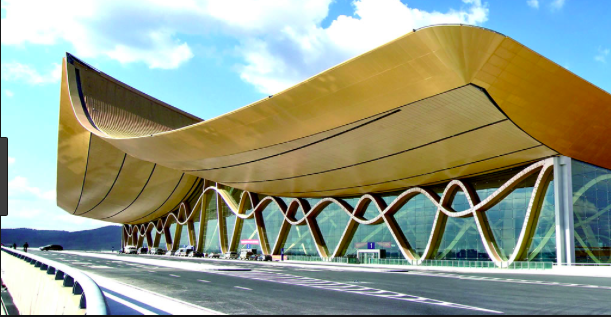
One of the biggest and busiest airports in China is set to grow much larger. Kunming Changshui International has only been open for six years, but it recently received national approval — and presumably state funding — to increase its ability to handle passengers by nearly 300 percent over the next decade.

Today, Changshui is the country’s sixth busiest airport based on a matrix involving passengers, aircraft ‘movements’ and cargo handled. In 2017, the facility handled 44,727,691 passengers, trailing only Beijing, Shanghai, Guangzhou, Chengdu and Shenzhen, according to statistics compiled by the Civil Aviation Administration.

The newly approved 2018 Changshui Airport Master Plan eyes a day in the not-so-distant future when the facility will see passenger traffic exceed 120 million people each year. In order to meet such demand, Yunnan province’s main travel hub will add additional 4,000-meter runways to augment the two that already exist.

A previous expansion plan first outlined in 2015 — a mere three years after Changshui first opened — called for the construction of a second major terminal and two extra runways. Already underway, that scheme has since been updated and was given the green light by Beijing in mid-October of this year. No verifiable cost estimates for the expansion have yet been made public.

Under the 2018 Master Plan, Changshui’s future runway count has risen to five and two ‘satellite facilities’ are scheduled for construction to supplement terminals 1 and 2. Work on Terminal 2 broke ground in 2015, and is expected to be completed sometime around 2020, as is at least one of the auxiliary runways. All construction detailed in the 2018 Master Plan will reportedly be finished by 2030.

Changshui was opened in 2012 at a cost of 23 billion yuan (US$3.3 billion) as a replacement for Kunming’s outdated and inadequate Wujiaba Airport. At that time, the facility was included in the ‘Go West’ development program (西部大开发), an enormous domestic economic policy designed to boost development in western China. Today, that strategy has been subsumed by the country’s Belt and Road Initiative.

It has long been rumored that Kunming would land contracts for an ever-growing number of intercontinental flights. And while connectivity between Yunnan and the countries of South and Southeast Asia have jumped significantly since 2012, consistent direct links to Europe and North America have not been so quick to materialize. With the addition of even more airstrips built to handle the world’s largest passenger planes, Changshui may finally be on its way.

Source: Go Kunming