

Lithuania plans to invest around EUR 700 mln into airport expansion

Lithuania’s government estimates that around 700 million euros will be invested into the expansion of the airports in Vilnius, Kaunas and Palanga by 2028. The country plans to continue having a network of three international airports.

«Vilnius, Kaunas and Palanga Airports might be expanded based on the modular principle in the future, if needed, to ensure continuous operation of these airports without any inconveniences for passengers and airlines,» Transport Minister Rokas Masiulis was quoted as saying in a statement issued after a Tuesday sitting of a government commission on strategic projects when guidelines for the strategic plan on the development of Lithuanian airports were presented.

A concept for the development of the airports’ infrastructure is expected to be endorsed in November-December.

Prime Minister Saulius Skvernelis stressed the need to build integrated transport infrastructure when expanding the airports.

«The expansion concept for the airports is being coordinated with the construction of the European-gauge railway Rail Baltica. The airports and Lietuvos Gelezinkeliai (Lithuanian Railway) have not had joint project so far. But only an integrated transport system will increase Lithuania’s competitiveness in the region,» the prime minister said in the statement.

Vilnius Airport plans to finish the reconstruction of the departure and arrival terminals by 2028. A new passenger terminal is set to be built in Kaunas and it will be integrated with the Raila Baltica railway line as an underground railway station will be built.

Kaunas Airport also plans to expand aircraft repair and maintenance activities.

Meanwhile, the runway at Palanga Airports will also be reconstructed.

Source: The Baltic Course
China is building 8 new airports a year

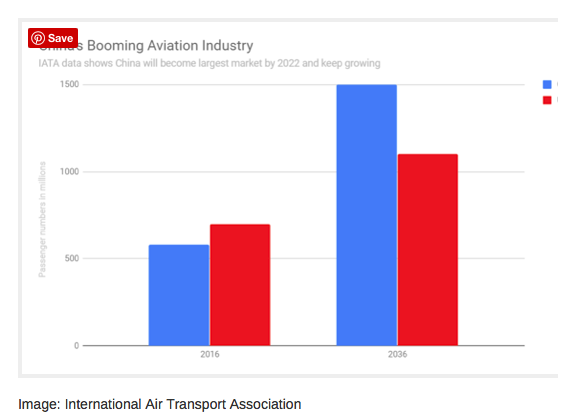
China will become the world’s largest aviation market by 2022, according to the International Air Transport Association, as an expanding middle class and government support for the sector fuel demand for flights and airport construction.
The five charts below show how demand is growing. The first chart illustrates the International Air Transport Association’s prediction that China will add 921 million new passengers by 2036, taking total passengers to 1.5 billion. That compares with 1.1 billion in the US.

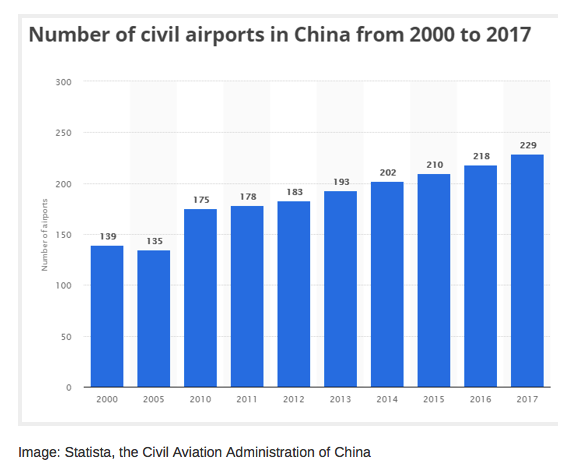
To cope with the surge in passengers, the world’s second largest economy plans to build 74 new civil airports by 2020, taking the total to 260. That’s up from 175 in 2010, and amounts to more than eight new airports per year. The data on new airports was revealed in the Civil Aviation Development 13th Five-Year Plan, released by the Civil Aviation Administration of China.

The development underscores how changes in the makeup of China’s population are set to ripple around the globe. The nation’s economic prosperity has resulted in income growth for much of its population, bolstering the middle class. Thirty-five percent of the population is projected to be in the upper-middle-class bracket or better by 2030, up from 10% in 2015.
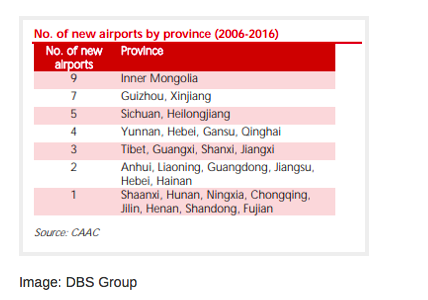
Some of the more remote regions, including Inner Mongolia, Guizhou, Xinjiang, Sichuan, and Heilongjiang, have seen five or more airports built in the last decade, according to research from DBS Group.

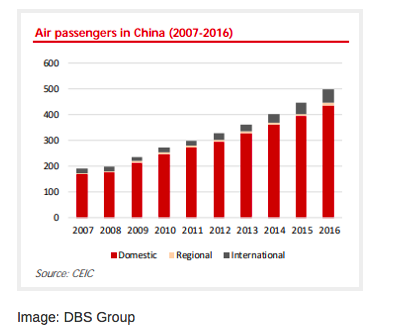
The growth has been in both domestic and international travel and, as this graph shows, there’s room for more expansion:


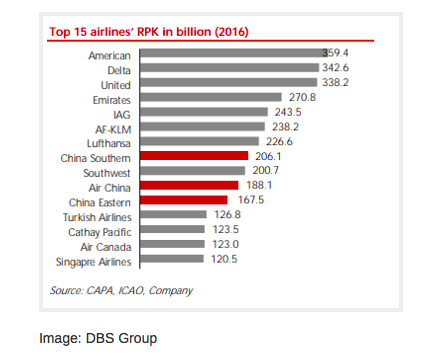
All that means the nation’s three largest airlines: Air China, China Southern Airlines, and China Eastern Airlines are going to become even bigger international players, challenging the dominant US airlines: American, Delta and United and competing for passenger numbers.
This chart shows the biggest airlines measured by revenue passenger kilometres, RPK, a measure of passenger volumes.

The effects won’t just be felt in China, with increased airline competition potentially pushing down prices and passengers getting used to stopping off in Guangzhou, rather than one of the more traditional major airports for transfers.

Source: The European Sting. Author: Emma Charlton, Writer

Forest-inspired terminal with indoor waterfall planned for Bangkok Airport

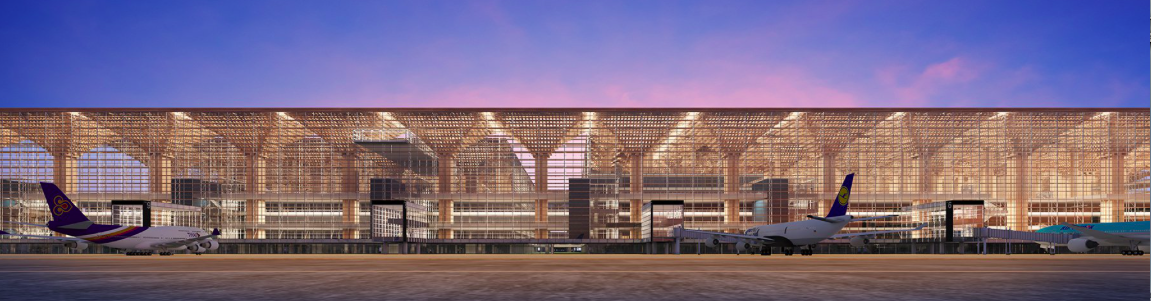
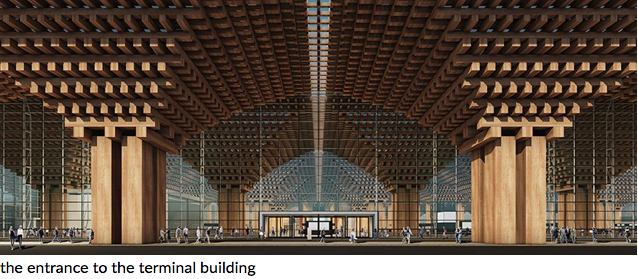
DBALP — the architecture firm led by duangrit bunnag — has been selected to design a major new terminal building at bangkok’s suvarnabhumi airport. the scheme references thailand’s lush, vegetation-filled landscapes with a design that immerses passengers within a ‘forest’ environment. between the airport’s passenger and commercial buildings, the design team plans to construct a tropical setting that features a cascading waterfall.

The design comprises two modular structures, that measure 36×36 meters and 18×18 meters respectively. supported by distinctive wooden columns that appear as giant trees, these enclosures cover a total of 348,000 square meters. meanwhile, the indoor forest, which spans 16,132 square meters, is designed to be a ‘live demonstration of how human beings could inherit the natural tropical ecological system’.

Sorce: Design Boom

UPDATE: Winning airport design accused of plagiarizing Kengo Kuma’s Wooden Bridge Museum.

Duangrit Bunnag, the renowned local architect who won the bid to design Suvarnabhumi airport’s second terminal, has denied plagiarising the work of a Japanese architect.

«I didn’t copy anyone else’s work. Those who follow my work will know that I created a similar image in my previous designs, such as for a hotel in Sri Lanka,» Mr Duangrit told The Standard, a local online news portal.bangkokpost.com

Duangrit Bunnag’s firm DBALP Consortium, along with Nikken Sekkei, EMS Consultants, MHPM, MSE and ARJ Consortium, were recently announced as winners of the Suvarnabhumi Airport Terminal 2 Project design contest. Focused on expanding the Thailand airport, the competition design sparked online accusations of plagiarizing Kengo Kuma’s Wooden Bridge Museum in southern Japan.

DBALP Consortium’s winning airport design

Atlanta airport looks to add gates rather than new terminal

Hartsfield-Jackson International Airport officials have shelved plans to build a $1.5 billion international terminal in favor of a more modest proposal to add new gates to its existing terminals, the Atlanta Constitution-Journal reported August 18, 2018.

After determining that the price for the proposed new Terminal G was too steep, officials are looking at extending the airport’s existing domestic terminals to accommodate the new gates. The plan could be incorporated into the Atlanta airport’s ongoing $6 million expansion and modernization project, which already includes the addition of five new gates in Concourse C.

“We have an immediate need for additional domestic gates,” said Tom Nissalke, planning and development manager at the world’s busiest airport by passenger volume.

Options include extending Concourse T and adding six to eight gates, or adding two new gates each to Concources C, D, and E. Those plans would cost approximately $400 to $500 million each, and the latter plan would require the relocation of airport taxiways.

The Atlanta airport currently has 193 gates.

Source: Business Traveller