

 Plattsburgh International Airport held a ribbon-cutting to celebrate the first United Express flight arriving this week. The airline, operated by SkyWest, took over the airport’s essential air services agreement from PenAir Airlines, and will offer two nonstop daily flights weekdays, and a daily flight on weekends, to Washington, D.C.’s Dulles International Airport. United says the daily flights on 50-seat passenger jets will connect the North Country, and Montreal, to major destinations in the U.S. and worldwide.
The airport hopes its 5-year, multi-million dollar expansion, and the opening later this year of its new international arrivals center and U.S. Customs facilities will draw interest from other airlines looking to offer flights to other U.S. destinations, the Caribbean, Mexico, or even Europe.
Construction of new Mozambique airport to commence in October
Mozambique’s Transport and Communications Minister Carlos Mesquita says work on Xai-Xai Airport in Gaza province is expected to begin in October.The Chinese government granted the Mozambican government US$60 million for construction of the new airport in Xai-Xai city, some 205 kilometres north of the capital Maputo.
Mesquita told journalists on Thursday that two public tenders related with the airport are to be launched, one in China and one in Mozambique.
“The Chinese tender will select a contractor to build the runway while the tender in Mozambique will identify companies to build access roads and install the services to support the airport’s activities,” Mesquita said.
Philippines: DOTr pushing for dev’t of new airports to complement NAIA, Clark
 The Department of Transportation (DOTr) is pushing for the development of other gateways to complement the Ninoy Aquino International Airport (NAIA) and the Clark International Airport (CRK).
At least two airport development projects are now being prioritized — building a new airport in Bulacan and developing the Sangley airport in Cavite. This airport complementation strategy is aimed at decongesting NAIA, give travelers more options, and spread development across Luzon.
“The idea of having multiple airports is something that the world’s biggest economies do. Ideally, there should be a train service linking these airports, which is also being pursued by the government. This complementation strategy was already part of the air transport roadmap from day one, and rest assured, that’s what we are going to do,” Transportation Secretary Arthur Tugade said.
The new Bulacan airport, an unsolicited proposal from the San Miguel Holdings Corp. (SMHC), was approved by the National Economic Development Authority (NEDA) Board last April 25, subject to resolution of pending issues, including a submission of “Joint and Several Liability” agreement by SMHC and its parent company.
After submitting the revised Concession Agreement, along with the Risk Allocation Matrix, the NEDA and the Department of Finance (DOF) submitted their comments last August 9, and are now under consideration of SMHC. After which, the DOTr will commence negotiations with SMHC to finalize the draft Concession Agreement and submit the same to NEDA Investment Coordination Committee, and begin the Swiss Challenge process.
The proposal includes the building of four parallel runways and a passenger terminal with 100 million passengers capacity per year.
Meanwhile, the DOTr also welcomes the proposal of the provincial government of Cavite to develop the Sangley Airport. The approval process, however, will be defined after the Cavite LGU has determined the legal framework for its implementation.
While these projects are being developed, the Manila International Airport Authority (MIAA) Board has already approved the grant of original proponent status to the NAIA Consortium for the airport’s rehabilitation project. The concession period will run for 15 years.
Apart from these airports in Luzon, Tugade said several other airports are undergoing various stages of implementation. Among them is the new Bohol (Panglao) airport, which will be opened within the year. The Bicol International Airport in Albay is now also being constructed after 11 years of delay. The Siargao and Bukidnon airports are also in the works.
“Apart from these new gateways, we are improving our existing provincial airports. We are extending and expanding runways, building new passenger terminal buildings, and generally improving the facilities,” Tugade said. (DOTr PR)
Source: Philippine News Agency
Melbourne to reconfigure domestic terminal for int’l ops
 Melbourne Tullamarine airport said it will reconfigure its domestic terminal and install «swing gates» allowing both domestic and international operations within the next five years, The Airport Professional has reported.
The reconfiguration would allow the airlines, mainly Qantas (QF, Sydney Kingsford Smith) and Virgin Australia International (VA, Brisbane Int’l), to use their widebody aircraft more flexibly for both types of flights.
«Swing gates» will be installed both in Terminal 1, used by Qantas, and in Terminal 3, used by Virgin Australia. Initially, the airport plans to convert just three Code E gates, but this number is set to grow to six to eight within a decade.
«What these projects are intended to do is meet that international growth challenge by using latent or spare capacity in the domestic terminals,» airport Planning Executive Michael Jarvis said. «[The aircraft] might have come in from a domestic sector, it might be going off to an international destination in Asia or North America and the airline can leave the aircraft at the gate without having to tow it to the international terminal with all of the fuss and money that involves.»
Both Australian airlines, as well as all foreign carriers, currently use Terminal 2 for international operations. The facility is sandwiched between Terminals 1 and 3 and has limited potential for expansion
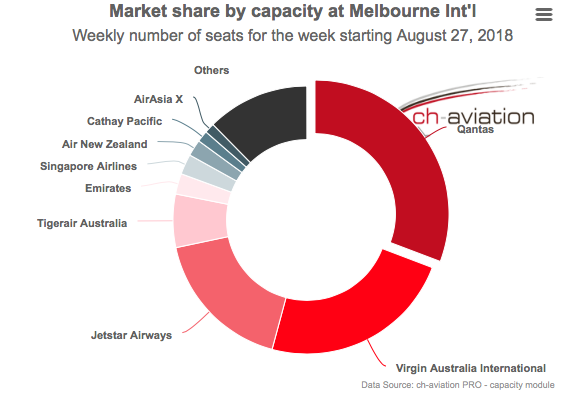
According to the ch-aviation capacity module, Qantas and Virgin Australia are currently the largest airlines serving Melbourne with 30.8% and 23.4% market share by capacity, respectively. Qantas operates 765 weekly departures, including 85 on international routes; while Virgin Australia operates 588 weekly departures of which 33 are to destinations abroad.
The airport also has Terminal 4, which is used by local LCCs, such as Tigerair Australia (TT, Melbourne Tullamarine) and Jetstar Airways (JQ, Melbourne Tullamarine).
Source: ch-aviation.com